
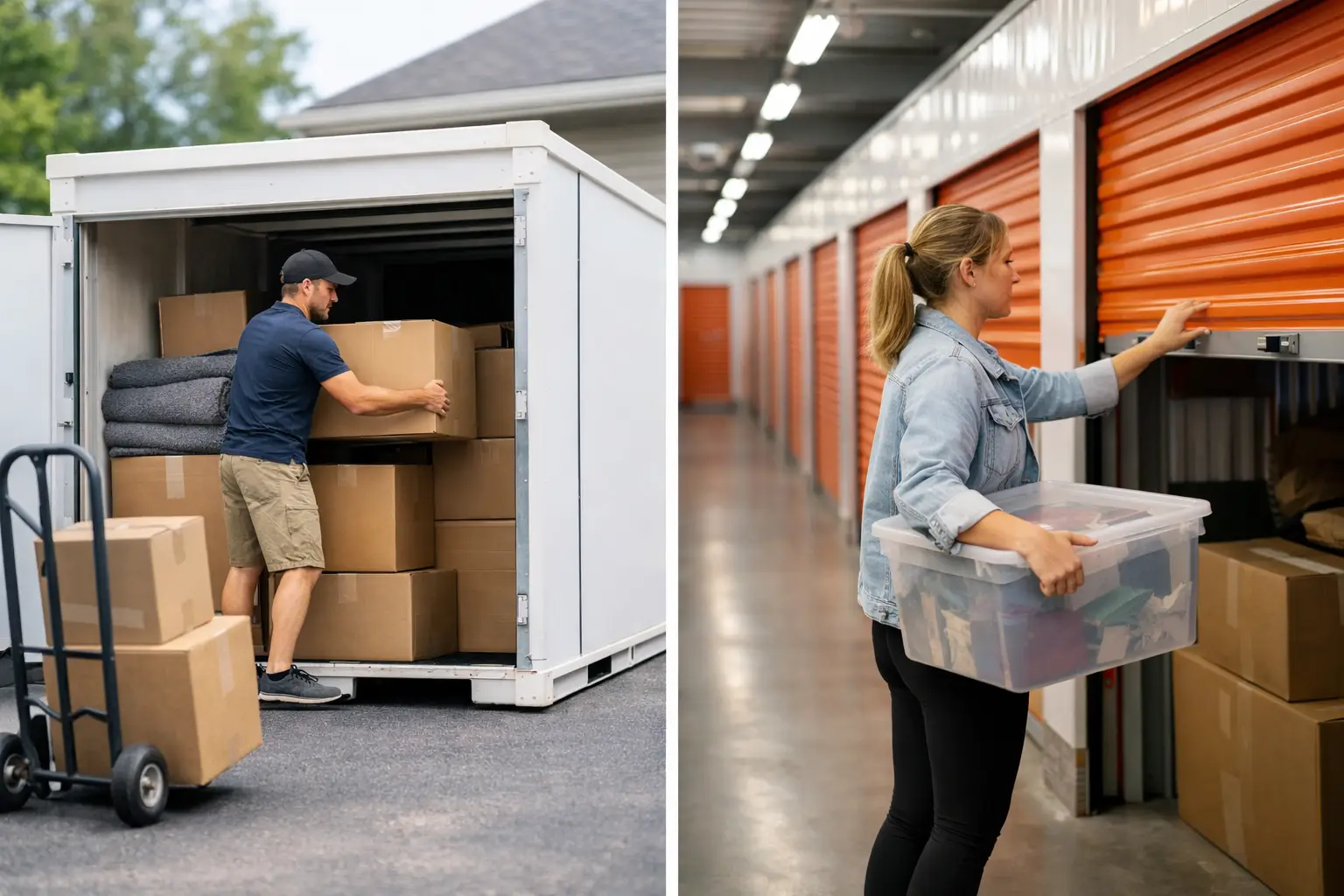
Portable Storage vs Self Storage
If you are staring at a move, a remodel, or a business space that suddenly feels too small, the choice between portable storage vs self storage can affect far more than where your stuff ends up. It affects how many trips you make, how much heavy lifting you do, how tight your timeline feels, and how much disruption you deal with along the way.
For some people, a traditional self-storage unit is still the right call. But for many homeowners, renters, contractors, and small businesses, portable storage solves problems that self storage simply does not. The best option depends on what you are storing, where you need it, and how much flexibility you want.
Portable storage vs self storage: the basic difference
Portable storage brings the container to you. You load it at your home, business, or job site, usually on your own schedule. Then you can keep it on-site, have it moved to a new address, or place it in off-site storage.
Self storage works the other way around. You rent a unit at a storage facility and move your items there yourself. That usually means loading a vehicle or truck, driving to the facility, unloading into the unit, and repeating the process when it is time to move out.
That difference sounds simple, but it changes the whole experience. One option moves around your life. The other requires you to work around the facility.
When portable storage makes more sense
Portable storage tends to work best when convenience and flexibility matter as much as square footage. If you are packing up a house over several days, clearing space for a renovation, or managing materials at a job site, having storage delivered to you can save serious time and energy.
A big advantage is pace. You do not have to rush through a truck rental window or finish everything in one exhausting day. You can load when it makes sense for your schedule, not when the rental clock starts ticking.
It also cuts down on handling. Instead of moving your items from the house to a truck and then from the truck to a storage unit, you typically load once. That can reduce labor, lower the chance of damage, and make life easier if you are moving furniture, appliances, business inventory, or job-site equipment.
For on-site needs, portable storage has another clear edge. A container placed at your property gives you direct access to your belongings without driving across town. During a remodel, that may mean keeping furniture close but out of the way. On a construction site, it may mean tools and materials are where the crew needs them.
When self storage may still be the better fit
Self storage can be a good option if you need frequent access and do not want a container at your property. Some neighborhoods, parking layouts, or property rules make on-site container placement harder. In those cases, driving to a storage facility may be more practical.
It can also make sense for smaller, lighter storage needs if you already have a vehicle and do not mind transporting items yourself. If you are storing a few boxes, seasonal decorations, or extra household goods and your timeline is not urgent, a self-storage unit may be enough.
There is also a psychological factor. Some customers prefer keeping stored items completely off-site from day one. If you want everything out of sight immediately and do not need help with the moving side of the process, self storage can feel straightforward.
Still, the real comparison is not just monthly rent. It is total effort.
Cost is not just the monthly rate
A lot of people compare portable storage and self storage by asking one question first: which one costs less? Fair question, but the answer depends on what you count.
With self storage, the monthly unit rate is only part of the picture. You may also need a truck rental, fuel, moving help, packing time, extra trips, and possibly time off work. If the facility is not close by, access itself has a cost in gas and hours.
Portable storage often bundles more convenience into the service. You are paying for delivery, flexibility, and fewer handling steps. For customers who want to avoid truck rentals and repeated hauling, that value can outweigh a simple rate comparison.
This is where local service matters. A regional company with straightforward pricing and responsive scheduling can often give you a better overall experience than a one-size-fits-all national setup. If your timeline changes, you want a real answer from a team that knows the market and can adjust.
Loading, access, and physical effort
One of the biggest differences in portable storage vs self storage is how hard the process is on your body.
With self storage, you usually load into a vehicle, unload into a unit, and then do it all again later. That means more carrying, more lifting, and more chances to bump a wall, scratch furniture, or strain your back.
Portable storage reduces those extra steps. Ground-level loading is especially helpful because you are not dealing with steep truck ramps or repeated transfers. That matters for families moving on a weekend, older adults downsizing, and business owners who do not have time to turn every storage task into an all-day project.
Container design matters too. Weatherproof steel construction, sealed doors, and ventilation are not marketing extras. They affect how well your belongings hold up in real conditions. If you are storing furniture, documents, tools, retail fixtures, or equipment, you want something built to protect what is inside.
For customers who also need transportation, level delivery helps reduce shifting in transit. That is one of those details people do not think about until they open a container and see what moved.
Best uses for portable storage
Portable storage is especially useful when storage is tied to a project, not just a place to park belongings. That includes moving between homes, staging a property for sale, renovating a kitchen, handling estate cleanouts, or creating temporary room for a growing business.
It also works well for commercial and construction use because the container can stay where the work is happening. Instead of burning time driving back and forth to a facility, crews can access what they need on-site. For businesses, that can mean storing excess inventory, files, fixtures, or equipment without taking up valuable floor space.
In markets like Fort Worth, Amarillo, and Oklahoma City, where customers may be managing moves across town, job sites, or suburban properties with enough placement space, portable storage often lines up well with how people actually work and move.
Best uses for self storage
Self storage still has a place. If you live somewhere with tight access, strict HOA rules, or no practical spot for a container, a facility unit may be the cleaner option. It may also suit long-term storage when you do not need regular loading or transportation support.
And if climate-controlled indoor storage is your top priority for certain sensitive items, that could tilt the decision depending on what you are storing. Not every situation calls for the same setup.
The main thing is to choose based on your real use case, not just habit. Many people go straight to self storage because it is familiar, even when the process creates more work than necessary.
How to decide which option fits your situation
Start with three questions. First, do you want storage brought to you, or are you comfortable hauling everything to a facility? Second, do you need storage only, or do you also need help with the moving part? Third, will on-site access make your life easier during the project?
If your priority is simplicity, fewer trips, and more schedule control, portable storage usually has the advantage. If your property cannot accommodate a container or you only need a basic off-site unit for a small amount of stuff, self storage may be enough.
For many people, the deciding factor is not storage at all. It is stress. If one option removes a truck rental, cuts out multiple loading cycles, and lets you pack on your own timeline, that is not a small difference. It changes the whole job.
A good storage solution should make the next few weeks easier, not add one more errand to a schedule that is already packed. That is usually the clearest answer.